
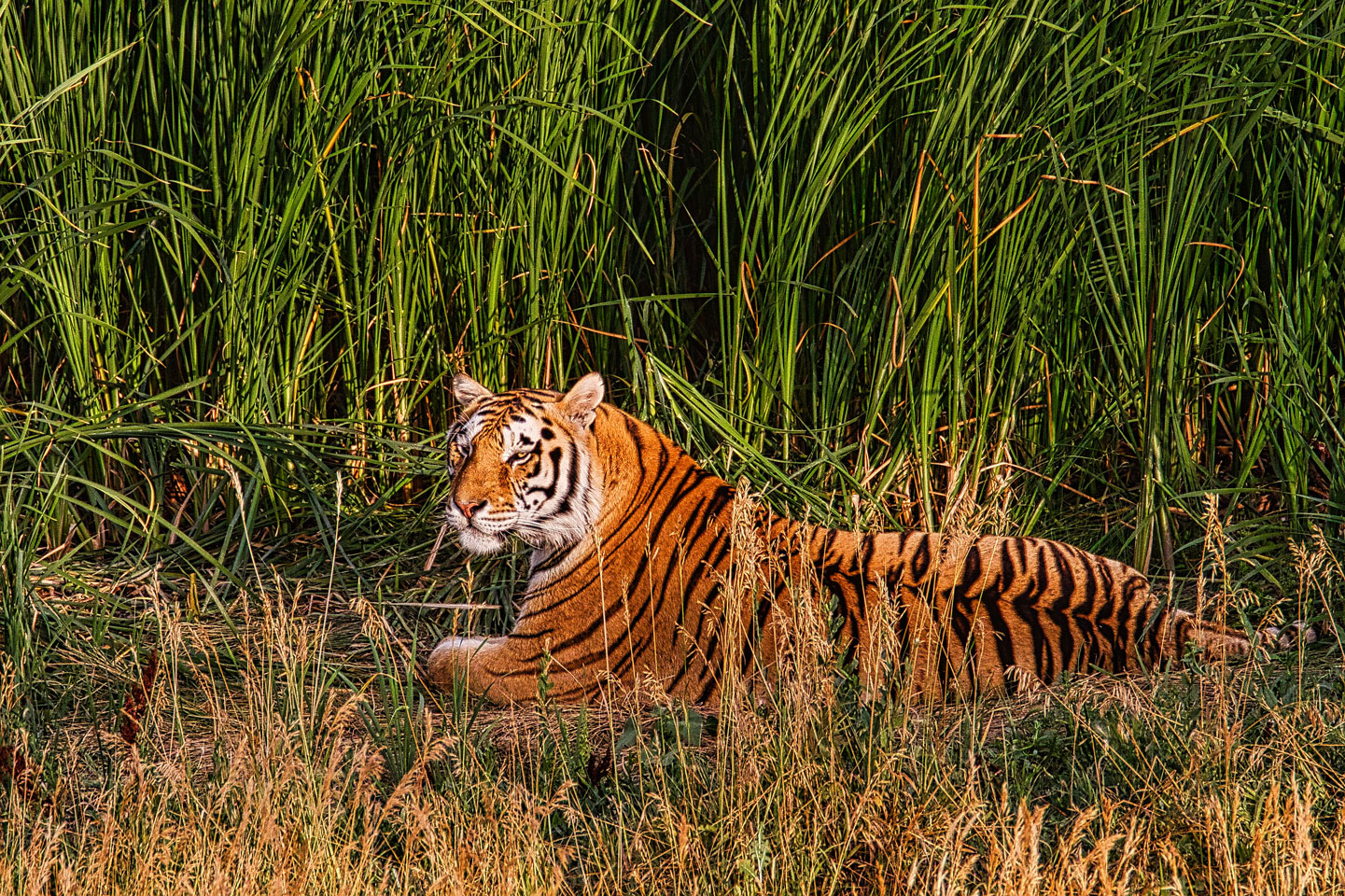
For two decades, an outdoor preserve near Denver, Colorado, has invited visitors to view rescued animals as they thrive in natural habitats.
By George Moore, F460576
February 2021
It probably is safe to assume most of us have visited at least one zoo in our lifetime. We are all familiar with the small enclosures, fenced areas, and cages in which zoo animals reside — animals that are intended to roam free in the wild, among them tigers, bears, and other mammals. I also would guess that very few of us have had the opportunity to view these same animal species in the wild in Africa or other countries, or in the United States’ mountainous backcountry.
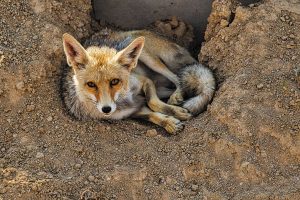
A fox at the Wild Animal Sanctuary.
Although it’s not in the jungles or savannah of Africa, or deep in the Rocky Mountain or Alaska wilderness, you can view many big cats, bears, foxes, wolves, and other animals in a more natural setting at the Wild Animal Sanctuary, about 40 miles northeast of Denver, Colorado.
The Wild Animal Sanctuary is just that – a sanctuary for rescued wild animals. This nonprofit organization, established in 1980, is dedicated to rescuing and providing permanent homes for abused, abandoned, or neglected wild animals. The vast majority of them were confiscated by local or federal law enforcement agencies or other legal action. With few exceptions, all of the rescued animals were born in captivity.
These animals represent just a small fraction of the millions of wild animals illegally bred and sold as pets, neglected in private homes, or abused in disreputable wild animal shows and circuses. Although a majority of the animals at the sanctuary are from the United States, many come from other locations, such as Mexico, Central and South America, Europe, and Asia. Officials at the sanctuary maintain strong relations with many foreign governments, and with law enforcement and wildlife protection agencies around the world.
Although the numbers vary throughout the year, the sanctuary has more than 600 lions, tigers, bears, wolves, and other exotic animals at its three locations, which together encompass more than 10,000 acres. A 9,684-acre sanctuary near Springfield, Colorado, and a 41-acre preserve near Boyd, Texas, are not open to the public. The 789-acre sanctuary northeast of Denver is the only one that admits visitors. Together, these three facilities form the largest carnivore sanctuary in the world: a one-of-a-kind, specially designed area where rescued animals once confined to concrete-and-steel enclosures now live and roam freely in a natural setting.
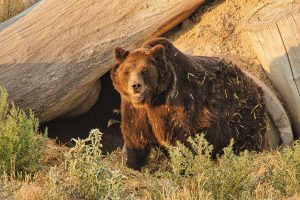
Animals at the sanctuary live in natural, protected areas unencumbered by traditional cages.
Transporting rescued animals from other states or countries to one of the Wild Animal Sanctuary locations poses logistical challenges, which have been overcome. The sanctuary maintains specialized trucks and transportation containers, along with trained personnel, to safely move the animals. The facility also contracts with specific air carriers for international transport and has agreements with several foreign governments that look to it for support.
To protect the rescued animals, the Wild Animal Sanctuary remained closed to the public for more than 20 years. Animals are territorial, and when strangers approach, they react instinctively with a fight-or-flight behavior. They either attack the stranger or run. When housed in conventional enclosures in captivity, the animals have neither option. The unhealthy stress this places on the animals results in unnatural pacing or fearful behavior.
After observing the animals over time, sanctuary staff noticed that most of them do not consider the air or sky above to be part of their territory. The animals didn’t perceive people elevated above them as threats. This realization led to the concept of constructing an elevated walkway through the sanctuary. In 2001, the facility opened to the public.
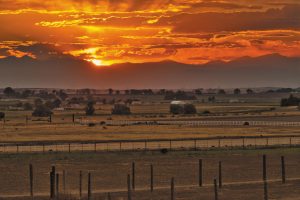
The sanctuary has three preserves; its 789-acre facility near Denver is open to the public.
The Sanctuary Experience
From the expansive parking lot, visitors enter the large and modern 48,000-square-foot Welcome Center. The facility includes a restaurant, an ice-cream bar, a gift shop, and a video of the sanctuary and its mission. Motorized wheelchairs and binoculars are available for rent.
At the Welcome Center, guests begin their tour by using stairs or an elevator to ascend to a walkway 30 feet above the sanctuary. The elevated walkway is a mile and a half long (3 miles out and back) and runs through the sanctuary. It is the longest elevated walkway of its kind in the world.
From there, visitors can view the animals below in natural enclosures, which range from yard size to several acres. Guidebooks, which are available at the Welcome Center, identify the types of animals to be seen at various locations along the walk. The guidebook also includes tragic stories of some of the rescued animals. Friendly and knowledgeable volunteers at various locations answer questions and identify and point out different animals.
Rest rooms are spaced along the walkway, and a snack bar and an education center are located near the turnaround. There, visitors can view the area where animals receive veterinary care and rehabilitation and are socialized with other animals. Each species receives care tailored to its specific needs. Videos in the education center show actual animal rescues.
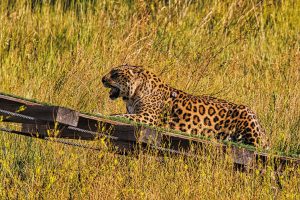
A leopard crawls along a manmade ramp at the sanctuary.
Allow four hours to leisurely walk and observe the animals. I suggest you contact the sanctuary to find out when the animals are most active. I visited in early August, during the last few hours of daylight, when the animals started to get active after their afternoon naps.
The Wild Animal Sanctuary is a great place to observe and photograph animals in a more relaxed, natural setting. I highly recommend including a visit when you are in the Denver-Fort Collins area.
Area Camping
Dakota Ridge RV Resort, C12487 *
17800 W. Colfax Ave.
Golden, CO 80401
(800) 398-1625
dakotaridgerv.com
Greeley RV Park & Campground, C10638 *
501 E. 27th St.
Greeley, CO 80631
(970) 353-6476
www.greeleyrvpark.com
Denver East/Strasburg KOA, C10742 *
1312 Monroe St.
Strasburg, CO 80136
(303) 622-9274
www.koa.com/campgrounds/denver-east
If You Go
Wild Animal Sanctuary
2999 County Road 53
Keenesburg, CO 80643
(303) 536-0118
www.wildanimalsanctuary.org
The sanctuary is open year-round seven days a week from 9:00 a.m. until sunset (except holidays). It is located off Colorado State Route 52, just a few miles east of the Hudson/Colorado 52 exit on Interstate 76. Prior to your visit, please check the facility’s website for more information, including temporary changes and closures that may be in effect in response to the COVID-19 outbreak.